The owl beaker

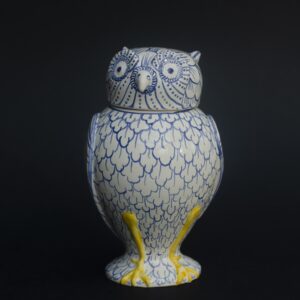
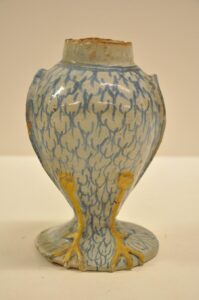
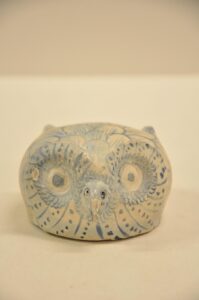
The owl beaker head and body (right) were made more than 400 years ago in the Netherlands. They don’t belong together but they do fit! Both are in the Boijmans van Beuningen museum, where I once had the opportunity to see them from up close. 
Why an owl? Owls produce pellets that they throw up. This looks like vomiting, which humans do when drinking too much from an owl beaker. This is only one possible explanation.  
The owl was used for all kinds of symbolic reasons in art around 1600, but not all of these symbolic values are easy to connect to these cups. However, owl beakers were sometimes given away as prices for shooting competitions, likely because the owl was used as a decoy for catching other birds.
The owl beaker was thrown on the potters wheel and then decorated with all the additional details. The glaze is a tin glaze with blue (cobalt) painting. 

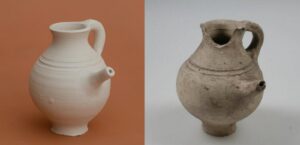
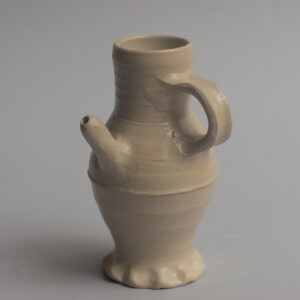
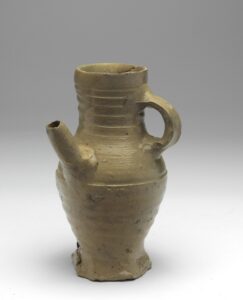
Bottles for feeding kids have a long history! Here are a Roman example and a medieval one, alongside the replicas that I made. The very round Roman bottle was found in the Netherlands  but I have no exact dating with it. It’s part of the RMO collection in Leiden. The medieval jug has the advantage that it’s made of stoneware. It’s probably easier to keep it clean. The jug was made in Langerwehe around 1350-1400. The original is in the Boijmans van Beuningen museum.


Behind the scenes in the pottery

I was visited by V.Birchwood for this video. You get to see the production process of a stoneware cup – from kickwheel to wood kiln. The video also contains an interview. These sessions turned out to be a good moment to reflect on trial and error. 


Puntneuskruik on television

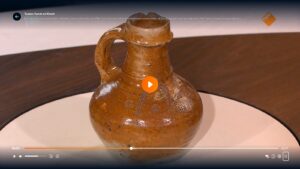
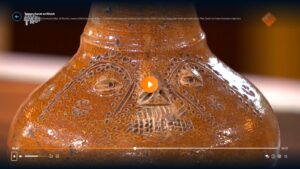
Yesterday this facejug was on Dutch television. I would like to add and correct a couple of things.
The historian in the show doubts that the jug was found in an Amsterdam canal. I would say it’s not unlikely, since many comparable pieces have been found in Amsterdam (including the one I own myself).
The production region of the “puntneuskruik” is Aken and Raeren. The jugs were often made with a pinched foot, but a flat base wasn’t particularly uncommon. Comparable facejugs are usually dated between 1470 and 1550. I wouldn’t dare to date a piece more specifically without a finding context.

I understand that the experts in the show have to know a lot about a huge range of items, so these remarks are not meant as critique.

You can watch the show here. The fragment with the facejug is 15:53 – 20:25
https://npo.nl/start/afspelen/diverse-musea-1_22

Fresh pottery from the kiln

Fresh pottery from the kiln. Replica’s of mostly medieval and early modern ceramics. An owl beaker, Italian majolica, Delftware, Spanish lusterware, a puzzle jug and more!

Decorating an owl beaker

Some time ago, I had the opportunity to see a 400 year old owl beaker in the Boijmans van Beuningen depot. Here I’m working on a replica. The technique used for decorating this kind of luxury pottery was oxide pigments on top of a white tin glaze. In this video I’m working with cobalt, which will turn blue when fired.


Wig stand or…

The stoneware object to the right is from Museum Delligsen and it’s filed as a 19th century wig stand. The dating is 1831 and it’s 24,1 cm tall.
The object to the left is my replica, currently for sale on the stock page. 
The Delftware object with a round head below (c. 1680 – c. 1690, 25 cm tall) is from the Rijksmuseum in Amsterdam. The sign in the museum says: “Objects such as this were formerly called wig stands. However, as they occur in many different shapes and sizes, they were most likely not actually used for wigs. They may simply have been decorative objects without a specific purpose.” The other Delftware object with a truncated octahedron-shape on top is only 14.9 cm tall (c. 1685 – c. 1690, also from the Rijksmuseum Amsterdam). That one is obviously not the best place to put your wig. 
What do you think: is the stoneware object from Museum Delligsen a wig stand or not?

Peasant dance jug

This late 16th century pitcher is the background of a cartoon scene. You can see two bagpipe players, a bunch of couples dancing and one guy vomiting on the ground. Some dancers are holding items like a flail, a leaf, a pitcher or a dagger. Who are these people and what’s the meaning of their appearance? I’ll post some answers later!
 
Left: replica jug made by me. Right: an original made in Raeren and found in Emden, Germany.